
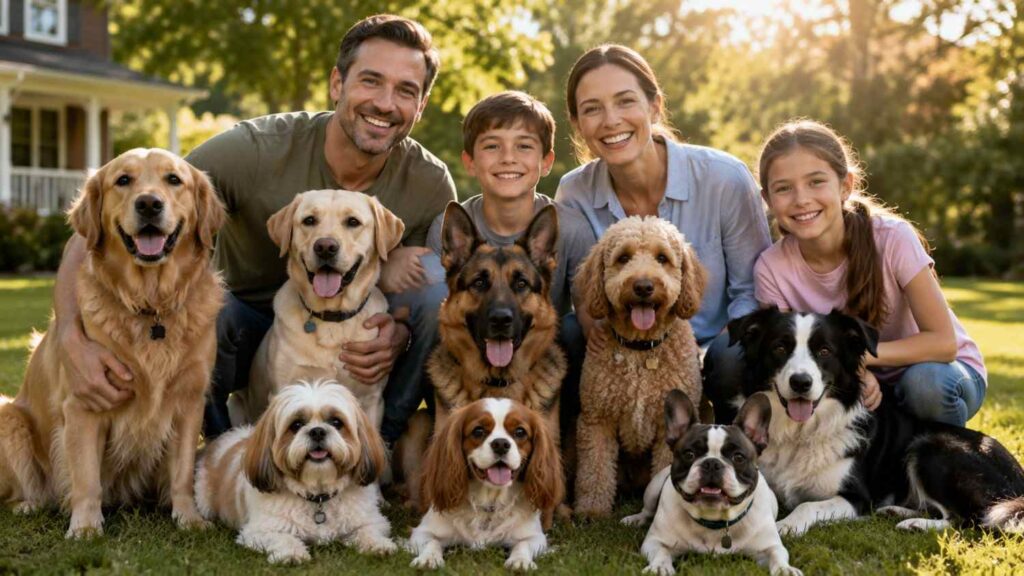
Top 10 Dog Breeds for Families: Finding the Right Family Companion
Choosing among the Top 10 Dog Breeds for Families is about far more than finding an attractive puppy or selecting the breed your friends recommend. A dog may share your home for many years, so temperament, exercise requirements, training needs, grooming, size, and everyday compatibility all deserve serious consideration. The right family dog should fit into your lifestyle rather than forcing the entire household to reorganize around unrealistic care demands.
Many breeds have characteristics that can make them appealing family companions. Labrador Retrievers and Golden Retrievers are widely known for sociability and enthusiasm. Poodles combine trainability with an athletic nature. Beagles offer a smaller but energetic option, while Newfoundlands and Bernese Mountain Dogs appeal to families comfortable caring for very large dogs. Smaller companion breeds such as Cavaliers and Bichons can work well in households where space is more limited.
However, breed reputation is only one part of the decision. Individual temperament, socialization, health, training, previous experiences, and the way children interact with the dog all matter. No responsible guide can guarantee that every member of one breed will behave identically. The goal of this article is therefore to help you compare strong family-dog candidates while understanding the practical responsibilities that come with each choice.
What Makes a Dog a Good Fit for Family Life?
A good family dog is one whose overall needs and temperament fit the household’s daily routine. Friendliness is certainly valuable, but it should not be the only criterion. Families need to consider energy level, physical size, trainability, coat care, social behavior, noise, exercise, and how much supervision younger children will require. A breed that looks ideal on paper may still be difficult if its daily needs exceed what the family can consistently provide.
For additional perspective when comparing breeds, families can also review this guide to family dog breeds alongside factors such as lifestyle, temperament, and activity level.
It is also helpful to think about what “family-friendly” means in your specific home. A family with teenagers who hikes every weekend may be well suited to an energetic retriever or Boxer. Parents with toddlers may prioritize a calmer routine and careful management. Someone who dislikes regular brushing should think carefully before choosing a heavily coated breed. Matching these practical details early can prevent frustration later.
The strongest decision usually comes from combining breed research with an evaluation of the individual dog. If you are adopting, speak with rescue staff or foster carers who know the dog’s behavior. If you are working with a responsible breeder, ask questions about temperament, health testing, socialization, and the parents. The better you understand both the breed and the individual, the easier it becomes to make a realistic family decision.
| Selection Factor | Related Topic | Key Considerations | Content Focus |
|---|---|---|---|
| Temperament | Family dog temperament | Affection, patience, sociability | Individual behavior and breed tendencies |
| Energy Level | Dog exercise needs | Daily activity, play, mental stimulation | Household activity compatibility |
| Size | Dog size and household fit | Space, handling, physical strength | Home and child considerations |
| Trainability | Obedience training | Learning ability, consistency, engagement | Training expectations |
| Grooming | Dog grooming needs | Coat care, brushing, maintenance | Ongoing care requirements |
| Shedding | Coat characteristics | Shedding level, cleaning needs | Household preferences |
| Socialization | Dog socialization | People, children, environments | Positive early experiences |
| Children’s Ages | Child and dog compatibility | Toddlers, school-age children, teenagers | Family-stage considerations |
| Home Environment | Family pet compatibility | Space, outdoor access, daily routine | Lifestyle matching |
| Owner Commitment | Responsible ownership | Training, veterinary care, supervision | Long-term family responsibility |
Look Beyond Breed Reputation
Breed reputation can help create a shortlist, but it should never become the entire decision-making process. Labrador Retrievers may have a reputation for being friendly, for example, yet individual Labradors can still vary in confidence, energy, sensitivity, and training history. The same principle applies to every breed in this guide. Genetics influence tendencies, but they do not produce identical personalities.
When meeting a dog, pay attention to how it responds to unfamiliar people, handling, movement, noise, and changes in the environment. An adult dog’s existing behavior may give you useful information about how it could adapt to your household. With puppies, the picture is less complete, which makes responsible breeding, early socialization, and continued training especially important.
Families should also avoid judging suitability from appearance alone. A beautiful coat, popular social-media image, or childhood memory can make a particular breed emotionally appealing. However, daily life involves exercise, grooming, veterinary care, training, feeding, supervision, and companionship. Choosing based on the complete ownership experience is much more reliable than choosing from reputation or appearance.
Match Energy and Size to Your Household
Energy level is one of the most important factors families underestimate. Some dogs need substantial daily exercise and mental engagement even when the weather is poor or the household is busy. Labrador Retrievers, Golden Retrievers, Boxers, and other active breeds may thrive in homes that enjoy walks, outdoor activities, training games, and regular play. Without appropriate outlets, energetic dogs can become difficult to manage.
Size matters in a different way. A large dog may be gentle but can still knock over a small child accidentally during excited play. Giant breeds also occupy more physical space, need larger beds and equipment, and can be more challenging to transport. Smaller dogs are easier to carry but may be physically vulnerable if young children handle them roughly.
Rather than assuming that small equals easy or large equals difficult, consider your home, activity level, physical ability, and children’s ages together. A calm large dog can suit some families better than a highly energetic small one. The most practical size is the size your household can train, exercise, supervise, and care for comfortably every day.
Consider Training and Grooming Too
Training should be treated as a normal part of family dog ownership rather than an optional extra. Even naturally sociable breeds need guidance about jumping, walking on a lead, settling indoors, greeting visitors, and responding to basic cues. A trainable breed can make the process easier, but consistency from the family remains essential. Everyone should follow similar household rules so the dog receives clear information.
Grooming requirements also vary significantly. A Labrador has a relatively simple coat but sheds. A Golden Retriever requires more brushing. Poodles shed less than many breeds but need regular professional or skilled home grooming to prevent coat problems. Bichons also require substantial coat maintenance. Long-coated giant breeds can add another level of brushing and cleanup.
These responsibilities affect both time and cost. Before choosing a breed, estimate what regular grooming, training support, equipment, veterinary care, and daily exercise will involve. Families who make these practical calculations in advance are better prepared for long-term ownership and less likely to feel overwhelmed once the dog becomes part of everyday life.
Best Large and Highly Trainable Family Dogs
Large, trainable breeds often appeal to families because they can participate in many activities while developing close relationships with household members. Labrador Retrievers, Golden Retrievers, and Standard Poodles are three especially recognizable examples. Each can learn a wide range of behaviors and activities, but their intelligence and energy also mean they benefit from structured engagement rather than simply being left to entertain themselves.
These breeds may suit families that enjoy walking, training, outdoor recreation, retrieving games, or other active routines. Their size makes early manners especially important. A friendly 30-kilogram dog that jumps enthusiastically can still overwhelm children or visitors. Teaching calm greetings, lead skills, impulse control, and household routines from an early stage makes family life easier.
There are also important differences between the three. Labradors have a short but shedding coat. Goldens require more brushing because of their longer coat. Poodles are often considered when shedding is a concern, but their coat requires significant grooming. The right choice depends not only on personality but on which care routine your family is most comfortable maintaining over many years.
1. Labrador Retriever
The Labrador Retriever remains one of the best-known family companion breeds because it often combines sociability, enthusiasm, intelligence, and a strong willingness to engage with people. Labs typically enjoy being involved in household activities rather than spending long periods isolated. Their retrieving heritage also makes play, carrying toys, swimming, and interactive exercise especially appealing to many individuals.
Families should be prepared for considerable energy, particularly during adolescence and young adulthood. A Labrador may be affectionate and friendly while still requiring structured exercise, training, and mental stimulation every day. Without enough activity, an energetic young Lab can become difficult to manage indoors. Consistent lead training and calm greeting behavior are particularly useful because of the breed’s physical strength and enthusiasm.
The short coat is relatively straightforward to maintain, but Labs do shed, so regular brushing and household cleaning are part of ownership. Families that want an affectionate, active dog and can commit to training and daily exercise may find the Labrador an excellent all-round choice. The breed is especially suitable for households that enjoy including the dog in regular activities.
2. Golden Retriever
Golden Retrievers are widely valued as family companions because they often combine an affectionate personality with strong trainability and a cooperative nature. They tend to enjoy close interaction with people and usually respond well to reward-based training. Their enthusiasm can make them excellent partners for active families that want a dog involved in walks, games, training, and outdoor activities.
Like Labradors, Goldens are not low-energy dogs. Young individuals can be lively and need appropriate physical activity together with mental engagement. Training should begin early so excitement does not become jumping, pulling, or poor impulse control. Their social nature also means they generally benefit from being part of the household rather than spending most of their time alone.
Coat maintenance is more demanding than with a short-coated breed. Golden Retrievers have a double coat that sheds and requires routine brushing, with more attention during heavier seasonal shedding. Families prepared for this grooming commitment may appreciate the breed’s combination of responsiveness, friendliness, and versatility. A well-matched Golden can become a highly involved companion rather than simply a passive household pet.
3. Poodle
Poodles are often associated with elegant grooming, but their appearance can distract from their working intelligence and athletic ability. Standard Poodles in particular can be active, capable family companions that enjoy learning and participating in structured activities. Their responsiveness makes them appealing to owners who enjoy training rather than simply teaching a few basic commands.
One major attraction is the curly coat, which sheds differently from the coats of many other breeds. However, “low shedding” should not be confused with “low maintenance.” Poodles require regular brushing, trimming, and professional or skilled home grooming. Families considering the breed should be comfortable with that ongoing commitment before choosing it primarily for coat-related reasons.
Poodles also benefit from mental stimulation. Intelligent dogs can become bored when life offers little variation or interaction, so training games, walks, play, and problem-solving activities can be useful. For families prepared to provide grooming and regular engagement, a Poodle can offer an excellent combination of trainability, athleticism, adaptability, and close companionship.
Friendly Medium-Sized Dogs for Active Families
Medium-sized family dogs can offer a useful middle ground between compact companions and very large breeds. Beagles, Boxers, and Collies each bring distinct strengths, but they are not interchangeable. Their exercise requirements, training style, coat care, and typical behavior differ enough that families should compare them carefully rather than choosing on size alone.
These breeds can be particularly appealing to households that enjoy active involvement with their dog. Beagles bring scent-hound curiosity and sociability. Boxers are known for energetic, playful personalities and substantial physical enthusiasm. Collies have a herding background that contributes to intelligence and responsiveness. All three tend to benefit from training and meaningful daily activity.
The key is deciding which type of activity fits your household. A Beagle may be fascinated by scent exploration. A Boxer may want vigorous interactive play. A Collie may enjoy training tasks that engage both mind and body. Understanding these differences makes it easier to choose a dog whose natural tendencies complement the family’s routine instead of continually conflicting with it.
4. Beagle
Beagles are compact hounds with a friendly, curious character and a long history of working in groups. Their social background can make them appealing companions for households that want a cheerful dog without moving into the size range of a retriever or giant breed. They often enjoy being around people and participating in daily family activity.
Their scenting ability is a major part of the ownership experience. A Beagle may become highly focused on an interesting smell and can be less responsive when its nose takes over. Secure fencing, reliable lead use, recall training, and enrichment that allows appropriate sniffing are therefore important. Families should not expect obedience to override natural hound instincts automatically.
Beagles also need regular activity despite their manageable size. They can become bored when given too little exercise or stimulation. For families willing to provide walks, scent games, training, and companionship, the breed can offer a lively balance of playfulness and manageable physical size. Prospective owners should simply appreciate the independent hound personality rather than expecting retriever-style responsiveness.
5. Boxer
Boxers are energetic, expressive dogs that often form strong relationships with their families. Their playful nature can make them entertaining companions for households that enjoy interactive dogs with plenty of personality. They are physically powerful, however, so early training and consistent household manners are important even when the dog’s intentions are completely friendly.
Young Boxers can be especially exuberant. Running, jumping, enthusiastic greetings, and energetic play may be part of daily life unless owners actively teach calmer alternatives. Families with very small children should think carefully about managing that physical excitement. Supervision, structured exercise, and reward-based training can help create safer and more predictable interactions.
The short coat requires less intensive grooming than many longer-coated breeds, which can appeal to busy households. However, lower grooming does not mean lower overall effort because exercise and training needs remain significant. A Boxer may be an excellent match for an active family that wants a loyal, playful companion and is comfortable investing time in movement, manners, and engagement.
6. Collie
Collies have a strong herding heritage and are often associated with intelligence, responsiveness, and close engagement with their people. Families interested in a dog that enjoys learning and participating in structured activities may find this appealing. Both Rough and Smooth Collies exist, giving prospective owners different coat-care experiences while retaining the breed’s general herding background.
Herding breeds often notice movement quickly and may be sensitive to their environment. This can make thoughtful socialization and training particularly useful. Rather than expecting the dog to fit automatically into a busy home, families should teach calm routines around children, visitors, outdoor activity, and household excitement. Mental work can be just as valuable as physical exercise.
Coat maintenance varies considerably between the Rough and Smooth varieties, so grooming should be researched before deciding. Families attracted to the classic long-coated Collie should be comfortable with routine brushing. In the right household, a Collie can provide a balanced combination of trainability, companionship, activity, and attentive family involvement.
Smaller Family Dogs for Companionship
Smaller dogs can be excellent family companions when their temperament and care requirements match the household. They may fit more easily into modest living spaces and can be simpler to transport than large breeds. However, their smaller bodies make gentle handling especially important, particularly in homes with toddlers who may not yet understand how to interact appropriately with animals.
Cavalier King Charles Spaniels and Bichon Frises represent two different types of small companion dog. Cavaliers are known for their affectionate, people-oriented nature and spaniel influence. Bichons are lively, social dogs with a distinctive coat and cheerful presence. Both can enjoy close household involvement rather than functioning as purely decorative pets.
Families should still evaluate exercise, grooming, health considerations, and training carefully. Small size does not remove the need for boundaries, daily activity, enrichment, and veterinary care. It also does not mean that rough handling is acceptable. A successful relationship depends on adults teaching children how to touch, play with, and respect a smaller dog safely.
7. Cavalier King Charles Spaniel
The Cavalier King Charles Spaniel is a small companion breed that often appeals to families wanting an affectionate dog without the physical scale of a retriever or giant breed. Cavaliers tend to enjoy close contact with people and can fit households looking for a dog that participates in everyday family life while remaining easier to handle physically.
Their smaller size can be an advantage in homes where space is limited, but it also creates a responsibility. Children need to understand that a small dog should not be grabbed, carried carelessly, chased, or treated like a toy. Calm handling and adult supervision are essential, especially when children are young or still learning appropriate animal interaction.
Cavaliers still need walks, play, training, and coat maintenance. They should not be viewed as dogs that require little attention simply because they are small. Families prepared to offer companionship, gentle exercise, grooming, and respectful handling may find the Cavalier a warm, adaptable household companion with a manageable physical footprint.
8. Bichon Frise
The Bichon Frise is another compact companion breed, but it brings a different coat and personality profile. Bichons are often lively, expressive, and people-oriented. Their relatively small body makes them practical for families that prefer a smaller dog, while their cheerful nature can make them engaging household companions rather than sedentary lap dogs.
The coat is one of the breed’s defining characteristics and also one of its major care requirements. Regular brushing and grooming are necessary to keep the coat in good condition. Families who choose a Bichon because they want less loose hair around the house should understand that reduced shedding does not eliminate grooming work.
Training, play, and socialization remain important as well. Small dogs can develop unwanted habits when families excuse behaviors they would not tolerate from larger breeds. Clear, kind boundaries help create a more predictable companion. With appropriate grooming, respectful handling, and consistent training, the Bichon can suit families seeking a sociable small dog with an active personality.
Gentle Giant Dog Breeds for Families
Giant dogs create a very different family experience from small and medium breeds. Newfoundlands and Bernese Mountain Dogs can be affectionate, impressive companions, but their physical scale changes nearly every practical aspect of ownership. Beds, crates, vehicles, food, grooming space, equipment, and veterinary handling all become more substantial considerations.
Temperament remains important, but size must be managed responsibly. Even a calm giant dog can accidentally knock into a child or adult. Training should therefore focus early on controlled greetings, lead walking, settling, handling, and calm household behavior. Families also need enough physical space to live comfortably with a dog that may occupy a significant portion of a room when resting.
Prospective owners should also research breed-specific health and lifespan considerations carefully with qualified veterinary and breed resources. Large and giant breeds can carry different medical risks and expenses from smaller dogs. Families prepared for these realities may find the companionship deeply rewarding, but giant-breed ownership is best approached as a deliberate commitment rather than an emotional choice based on appearance alone.
9. Newfoundland
The Newfoundland is a very large working breed known for a generally sweet and patient reputation. Its calm presence can make it attractive to families who love large dogs and have enough space to manage one comfortably. Newfoundlands historically worked around water, and their substantial build reflects a breed created for physically demanding tasks rather than compact household convenience.
Size is the most obvious practical factor. Adults are powerful dogs, which means lead manners, calm greetings, and cooperative handling are important from an early age. Families with young children should still supervise interactions carefully because even gentle movement from such a large dog can accidentally knock over a small child.
The heavy coat also requires consistent maintenance, and owners should expect more grooming and household cleanup than with a short-coated breed. Transport and veterinary handling require planning as well. For families comfortable with these demands, the Newfoundland can offer a distinctive combination of size, companionship, and generally patient temperament.
10. Bernese Mountain Dog
The Bernese Mountain Dog is another substantial working breed that appeals to families wanting a large, affectionate companion. Berners are often described as sweet-natured and closely connected to their people. Their striking tricolor appearance is memorable, but families should look beyond the coat and understand the responsibilities that come with a dog of this size.
Regular exercise is important, although the breed should not be selected solely by active households seeking an endurance athlete. Training, social interaction, and controlled movement are all valuable. As with other large dogs, polite lead behavior and calm greetings become particularly important because pulling or jumping carries much more physical force than it would with a small companion breed.
The coat requires routine care and sheds, so prospective owners should be comfortable with brushing and household hair. Families should also research breed-specific health concerns through qualified veterinary and breed resources before committing. For the right household, a Bernese Mountain Dog can provide affectionate companionship with a calm, substantial presence.
Family Dog Breed Comparison Table
| Breed | General Family Fit | Activity Needs | Grooming | Best Suited To |
|---|---|---|---|---|
| Labrador Retriever | Friendly and outgoing | High | Moderate | Active families |
| Golden Retriever | Affectionate and cooperative | High | Moderate to high | Families wanting an involved companion |
| Poodle | Intelligent and trainable | Moderate to high | High | Families prioritizing training and lower shedding |
| Beagle | Social and curious | Moderate to high | Lower | Families comfortable with hound behavior |
| Boxer | Playful and energetic | High | Lower | Active households |
| Collie | Responsive and attentive | Moderate to high | Varies by coat | Families wanting an engaged dog |
| Cavalier King Charles Spaniel | Gentle and companionable | Moderate | Moderate | Homes wanting a smaller companion |
| Bichon Frise | Sociable and lively | Moderate | High | Families wanting a compact dog |
| Newfoundland | Patient and very large | Moderate | High | Families with substantial space |
| Bernese Mountain Dog | Affectionate and substantial | Moderate | High | Homes prepared for a large breed |
The table is intended as a starting comparison rather than a guarantee of individual behavior. Dogs within the same breed can differ, and factors such as age, health, training, socialization, previous experiences, and current environment can influence how well a particular dog fits family life.
It is also useful to treat “activity” and “grooming” as broad categories rather than fixed scores. Exercise needs vary by age and individual health, while grooming can depend on coat length, season, clipping style, environment, and household expectations.
Families should therefore use the table to identify breeds worth researching in greater depth. The final decision should involve the individual dog, realistic household needs, responsible veterinary guidance, and a clear plan for training and supervision.
How to Choose the Right Family Dog
Looking through the Top 10 Dog Breeds for Families can help narrow your options, but selecting the right dog requires an honest evaluation of your household. It is easy to imagine the enjoyable parts of ownership while underestimating daily walks, training, feeding, grooming, cleanup, veterinary care, and supervision. The strongest match is usually the dog whose needs fit routines the family can maintain consistently.
One useful approach is to separate preferences from requirements. You may prefer a large dog, for example, but your home, car, schedule, or physical ability may make a medium dog more practical. You may like the look of a Poodle but dislike frequent grooming. You may love the friendliness associated with Labradors while lacking time for the exercise a young Lab can require.
For broader guidance on family dog selection, the AKC also recommends considering a family’s lifestyle, home environment, and children’s ages before choosing a breed.
Before making a final decision, involve everyone in the household. Discuss who will handle morning walks, feeding, training, grooming, veterinary appointments, and care during holidays. Children can participate in age-appropriate tasks, but adults remain responsible for the dog’s welfare. Planning these details in advance turns breed research into a realistic ownership decision rather than an emotional impulse.
Start With Your Real Lifestyle
Begin by examining what your household actually does during a normal week. A family may describe itself as active because it enjoys occasional weekend outings, yet a high-energy dog needs consistent exercise on ordinary work and school days too. Think about mornings, evenings, bad weather, busy periods, holidays, and times when motivation is lower.
Consider how long the dog may spend alone and whether the family can provide regular companionship, bathroom breaks, activity, and training. Different dogs tolerate routines differently, but no breed should be chosen on the assumption that social and exercise needs will simply disappear when life becomes inconvenient.
Your housing situation matters as well. Outdoor space can be useful, but a garden does not replace walks, engagement, or training. Apartment living can work for some dogs if exercise and management are appropriate. The question is not simply how much space you have. It is whether your lifestyle can consistently meet the individual dog’s physical and emotional needs.
Related Articles
Consider the Ages of Your Children
Children’s ages can significantly influence which dog feels manageable. Toddlers move unpredictably, may grab without understanding, and require close adult supervision around any animal. School-age children can begin learning structured rules about feeding, touching, training, and respecting rest. Teenagers may participate more actively in walks and care, although adults should still retain overall responsibility.
Dog size creates different considerations. Small breeds can be vulnerable to accidental injury from rough handling. Large, enthusiastic breeds may unintentionally knock over small children. Neither size category is automatically safer. What matters is the interaction between the child’s maturity, the dog’s temperament, training, and consistent adult management.
Parents should also consider how family life may change during the dog’s lifespan. A household without children today may plan to have children later. A puppy chosen for young teenagers may still be alive when those teenagers leave home. Thinking long term helps families select a companion whose needs remain realistic as routines evolve.
Use This Five-Step Family Dog Checklist
Start by deciding what level of daily exercise, grooming, and training your household can realistically maintain. Then compare breeds using those limits rather than choosing a favorite first and trying to make the lifestyle fit afterward. This simple change in order can eliminate many unsuitable options quickly.
Next, meet individual dogs where possible and ask detailed questions. If adopting, ask about behavior around people, other animals, handling, food, visitors, noise, and time alone. If purchasing from a breeder, ask about temperament, health testing, socialization practices, the parents, and what support is available after the puppy goes home.
Finally, prepare before bringing the dog home. Arrange veterinary care, identification, appropriate equipment, sleeping areas, training plans, safe child-dog boundaries, and a realistic routine. A thoughtful selection process cannot guarantee a perfect relationship, but it significantly improves the chance that both the family and the dog enter the arrangement with suitable expectations.
Five-step checklist:
- Define the size and energy level your household can manage.
- Compare grooming, training, exercise, and long-term care requirements.
- Meet and evaluate the individual dog whenever possible.
- Ask about temperament, health, socialization, and previous behavior.
- Prepare training, supervision, veterinary care, and household routines before arrival.
Build Safe Relationships Between Dogs and Children
Finding dogs good with children is only one part of creating a safe household. Children also need to learn how dogs communicate and when an animal should be left alone. A friendly family dog can become uncomfortable when repeatedly hugged, climbed on, disturbed while resting, or followed after trying to move away. Respectful interaction should therefore be taught from the beginning.
Adults remain responsible for supervision. Young children should not be expected to recognize every sign of canine discomfort or make mature decisions during exciting play. Supervision allows an adult to interrupt interactions before either the child or dog becomes overwhelmed. It also helps families reinforce good habits rather than only reacting after something goes wrong.
The dog also needs training, predictable routines, and safe areas where it can rest without interruption. A crate, bed, gated room, or other designated space can help, depending on the household and dog. When both children and dogs are taught clear boundaries, family interactions become easier to manage and less dependent on assumptions about breed reputation.
| AEO Question / Search Query | Topic to Cover | Related Concept | Search Intent |
|---|---|---|---|
| How should children interact with family dogs? | Child-dog interaction | Gentle handling, respect | Informational |
| What should children not do around dogs? | Safe behavior around dogs | Teasing, hitting, disturbing | Informational |
| Why is supervision important between dogs and children? | Adult supervision | Child safety, responsible ownership | Informational |
| How can children learn to respect dogs? | Teaching children | Boundaries, safe spaces | Informational |
| How can families build a safe relationship with a dog? | Dog-child relationship | Training, socialization, supervision | Informational |
| What should parents teach children about dogs? | Family dog safety education | Dog behavior, respectful interaction | Informational |
Teach Children How to Respect Dogs
Children should learn that a dog is a living animal with preferences and boundaries, not a toy. Basic rules include avoiding hitting, pinching, riding, grabbing ears or tails, taking food away, disturbing sleep, or chasing a dog that is trying to leave. These rules should be taught before problems occur rather than introduced only after the dog reacts.
It is also useful to teach children that affection should be voluntary. Some dogs enjoy close contact, while others prefer sitting nearby. Hugging can feel natural to a child but may make some dogs uncomfortable. Adults can show children how to offer gentle strokes, pause, and see whether the dog chooses to remain engaged.
Respect should extend to food, toys, beds, and quiet areas. Children do not need to test whether a dog will tolerate having possessions removed. Adults should manage resources and teach appropriate exchanges through training. Creating predictable boundaries protects both the dog and the child while helping children develop responsible behavior around animals.
Train and Socialize the Dog Consistently
Training gives families a practical way to communicate with the dog. Skills such as coming when called, walking politely, settling on a mat, leaving an item, waiting at doors, and greeting people calmly can make everyday life more manageable. These behaviors are particularly useful in busy homes where children, visitors, food, and activity can create excitement.
Socialization should involve positive, controlled exposure to the types of experiences a dog is likely to encounter. The goal is not to overwhelm the animal or force interaction. Instead, dogs should gradually learn that common people, sounds, surfaces, environments, and routines can be handled safely and calmly.
Consistency matters across family members. If one person encourages jumping while another punishes it, the dog receives mixed information. Adults should agree on basic rules and teach children how to participate appropriately. Professional reward-based training support can be valuable when families are unsure how to manage a behavior or want help building reliable household routines.
Quick Answer About Top 10 Dog Breeds for Families
The Top 10 Dog Breeds for Families in this guide are the Labrador Retriever, Golden Retriever, Poodle, Beagle, Boxer, Collie, Cavalier King Charles Spaniel, Bichon Frise, Newfoundland, and Bernese Mountain Dog. These breeds represent different sizes, energy levels, grooming requirements, and personalities, giving families several practical options instead of one universal recommendation.
Choosing among them should involve more than asking whether a breed is considered friendly. Families should compare exercise requirements, trainability, coat maintenance, available space, children’s ages, and the amount of time adults can dedicate to daily care. A highly energetic dog may be wonderful in one household and difficult to manage in another.
Breed tendencies also cannot guarantee how an individual dog will behave. Training, socialization, health, previous experiences, and responsible supervision all affect family compatibility. For that reason, I recommend using breed information as a starting point and evaluating the individual dog carefully before making a long-term commitment.
Frequently Asked Questions About Top 10 Dog Breeds for Families
Families comparing dog breeds often ask similar questions because the decision involves more than personality. Size, energy, grooming, experience level, children, housing, and training all influence the answer. A breed that works beautifully for one household can be frustrating in another, even when both families genuinely love dogs.
The FAQ answers below summarize the most important decision principles from the guide. They are intended as practical starting points rather than absolute rules. Breed tendencies can help narrow your search, but the individual dog’s temperament, health, training, age, and history still need to be considered.
If you are seriously considering a particular breed, go beyond general lists. Read reputable breed information, speak with veterinarians and responsible breed or rescue organizations, meet adult dogs where possible, and calculate the practical care commitment. Good research before bringing a dog home is much easier than trying to solve a fundamental lifestyle mismatch afterward.
What is the best dog breed for a family?
There is no single breed that is best for every family. Labrador Retrievers and Golden Retrievers are often strong candidates for active households because of their sociable, trainable nature, but they also need meaningful exercise and engagement. A quieter or smaller household may prefer a different breed entirely.
The best choice depends on your children’s ages, available space, daily schedule, experience, activity level, grooming tolerance, and the amount of training you can provide. Families should compare the complete care requirements rather than selecting a dog based only on friendliness or popularity.
Individual temperament matters too. A well-matched adult rescue dog may fit a family better than a puppy from a traditionally family-friendly breed. The most responsible approach is to use breed characteristics for initial research and then evaluate the individual dog and household compatibility before committing.
Which dog breeds are best with children?
Labrador Retrievers, Golden Retrievers, Collies, Newfoundlands, Beagles, Boxers, and several companion breeds are frequently considered for family homes. However, “good with children” should never be interpreted as a guarantee that every individual will tolerate every kind of interaction.
Children need to learn gentle handling, and adults should supervise young children around dogs regardless of breed. A patient dog can still become uncomfortable when repeatedly disturbed, cornered, climbed on, or handled roughly. Safe interaction depends on both sides of the relationship.
When choosing a dog for children, consider size, activity level, confidence, previous experience, and temperament alongside breed. Meeting the dog and discussing behavior with a knowledgeable breeder, rescue, or foster carer can provide information that a general breed description cannot.
What is a good family dog for first-time owners?
First-time owners often do well with dogs that are responsive to training and whose exercise and grooming needs fit their lifestyle. Labradors, Golden Retrievers, Poodles, and some companion breeds may be worth researching, but none should be considered effortless simply because they are popular.
New owners should think about the complete routine. A highly trainable dog still needs consistent teaching. A friendly dog still needs exercise and supervision. A low-shedding dog may require regular professional grooming. Understanding these tradeoffs prevents unrealistic expectations.
An adult dog with an established temperament can sometimes be easier for a first-time household to evaluate than a young puppy. Rescue organizations and responsible breeders can also help match families with suitable individuals. The best beginner dog is ultimately one whose needs the household is prepared to learn and meet consistently.
Are small dogs suitable for families with young children?
Small dogs can live successfully with children, but careful handling is particularly important. Their lighter bodies may be easier to injure accidentally if a toddler falls on them, picks them up incorrectly, or plays roughly. Small size should therefore not be mistaken for automatic child suitability.
Breeds such as the Cavalier King Charles Spaniel and Bichon Frise may appeal to families wanting a compact companion. Even so, the individual dog’s temperament, socialization, health, and comfort around children need to be evaluated.
Adults should supervise interaction and teach children to allow the dog to move away, rest undisturbed, and approach voluntarily. A small dog’s growl or avoidance should be taken seriously rather than dismissed because the animal is physically less intimidating than a larger breed.
Which family dog is best for an active household?
Labrador Retrievers, Golden Retrievers, Boxers, Poodles, and other energetic breeds may work well with families that genuinely maintain an active routine. These dogs often enjoy regular walks, training, games, and outdoor involvement rather than spending most of the day inactive.
The key word is “regular.” A long weekend hike does not necessarily compensate for minimal activity throughout the rest of the week. Families should consider whether they can provide appropriate exercise on school days, workdays, and during less convenient seasons.
Activity should also be adapted to the dog’s age and health. Puppies, adults, and senior dogs have different needs. Families can combine physical exercise with training and mental enrichment so the dog has multiple appropriate outlets rather than relying on high-intensity activity alone.
Is any dog breed completely safe with children?
No dog breed should be described as completely safe in every situation. Dogs are individuals, and behavior can be affected by pain, fear, stress, previous experiences, resource concerns, environment, and the way people interact with them. Even a dog with a long history of calm behavior deserves respectful handling.
Adult supervision is particularly important with young children because children may miss warning signs or behave unpredictably. Families should teach children not to disturb sleeping or eating dogs and to avoid rough physical interaction.
Safety comes from good selection, appropriate training, careful management, respectful child behavior, veterinary care, and attention to the dog’s communication. Breed information can help families choose suitable candidates, but it should never replace responsible supervision or individual assessment.
Conclusion
The Top 10 Dog Breeds for Families in this guide show how many different types of dogs can fit family life. Labradors and Golden Retrievers may suit active households seeking trainable companions. Poodles combine intelligence with different coat characteristics. Beagles, Boxers, and Collies offer distinct working-breed personalities, while Cavaliers and Bichons provide smaller companion options. Newfoundlands and Bernese Mountain Dogs appeal to families prepared for the realities of giant-breed ownership.
The most important lesson is that no breed should be selected from reputation alone. Exercise, grooming, size, training, children’s ages, available space, health, and individual temperament all matter. Families should ask whether they can meet the dog’s needs consistently for years, not merely whether the breed seems appealing today.
A carefully matched dog can become a valued member of family life, but that relationship still requires effort. Responsible supervision, reward-based training, veterinary care, socialization, realistic expectations, and respect for the dog’s boundaries all contribute to long-term success. The better the preparation before bringing a dog home, the stronger the foundation for the relationship that follows.